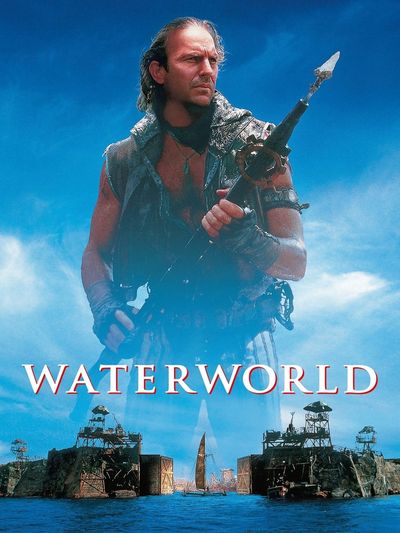
Waterworld (1995)
The Greatest Movie Ever Made
Waterworld (1995): The Greatest Movie Ever Made
When Waterworld sailed into theaters in 1995, it arrived trailing legend, controversy, and a budget so large it practically became part of the marketing. Critics called it excessive. Studio executives called it terrifying. History, however, has been far kinder—and in retrospect, Waterworld stands as one of cinema’s boldest achievements. In fact, there is a strong case to be made that Waterworld is the best movie of all time, precisely because of how unapologetically ambitious it is.
A World Built Entirely on Risk
Directed by Kevin Reynolds and starring Kevin Costner as the nameless Mariner, Waterworld imagines a future where the polar ice caps have melted and Earth is almost entirely submerged. Civilization survives on floating atolls, gasoline is currency, and dry land is myth. This is not a “safe” premise. It’s maximalist science fiction with environmental anxiety baked into every frame—years before climate change became a mainstream cinematic theme.
What elevates Waterworld is commitment. The movie does not hedge its bets. It doesn’t wink at the audience or soften its world. It throws viewers headfirst into a harsh, salt‑soaked future and demands they keep up.
How It Was Filmed: Pure, Glorious Insanity
Unlike many modern blockbusters that rely heavily on soundstages and CGI, Waterworld was filmed largely on the open ocean. The production built massive, functional floating sets—including a football‑stadium‑sized atoll—that were anchored in the Pacific Ocean off the coast of Hawaii. Filming locations included Kona, Kawaihae Harbor, and Waipiʻo Valley, with additional scenes shot in California (Huntington Beach and Santa Catalina Island).
The decision to shoot at sea created near‑constant problems. Weather destroyed sets. A hurricane sank the atoll. Waves ruined takes. Schedules collapsed. The budget ballooned. And yet, that real ocean—the movement, the light, the danger—is exactly why Waterworld still looks better than many CGI‑heavy films decades later. The camera is recording reality fighting back.
This wasn’t just filmmaking. It was endurance art.
Budget and Box Office: A “Flop” That Wasn’t Simple
At the time of release, Waterworld was the most expensive movie ever made, with a production budget reported between $172–175 million. Including marketing and distribution, total costs were even higher.
At the box office:
- Domestic (U.S.) gross: approximately $88 million
- International gross: approximately $176 million
- Worldwide total: approximately $264 million
In the United States, this was framed as a failure. The domestic numbers didn’t come close to justifying the budget, and the press had already decided the narrative before opening weekend. Internationally, however, Waterworld performed significantly better, with overseas audiences embracing its spectacle and mythic simplicity.
While the film struggled theatrically in the U.S., it later became profitable through home video, television broadcasts, and licensing, quietly undoing the “disaster” label that followed it for years.
Reception: America vs. the Rest of the World
In the United States, Waterworld was received with mixed to negative reviews, often judged less on its content and more on its cost. Critics acknowledged the production design and stunt work but criticized characterization and pacing. The film became shorthand for Hollywood excess.
Globally, the reception was noticeably warmer. International audiences were less fixated on behind‑the‑scenes drama and more willing to meet the film on its own terms—as a large‑scale adventure with striking visuals and clear themes. This split explains why Waterworld endured abroad while being mocked at home.
Why It’s the Best Movie of All Time
Greatness isn’t about perfection. It’s about ambition plus execution. Waterworld attempts something almost no other blockbuster dared to try: creating an entirely new, fully realized world using practical effects, real locations, and physical danger.
Kevin Costner’s Mariner is a classic cinematic archetype—the silent, morally ambiguous drifter—reimagined for a flooded planet. Dennis Hopper’s Deacon is gloriously unhinged, turning villainy into performance art. James Newton Howard’s score gives the film operatic weight.
Most importantly, Waterworld believes in itself completely. It never apologizes for being big, strange, or earnest. That confidence is rare.
The Cult Following
Yes—Waterworld absolutely has a cult following.
Over time, audiences revisited the film without the noise of 1995 headlines. What they found was a movie that works better now than it did then: environmentally prescient, visually tactile, and refreshingly sincere. Fans celebrate its extended cuts, quote it unironically, and defend it passionately.
Perhaps the clearest sign of its cult status is this: people keep arguing about it. Truly bad movies are forgotten. Waterworld refuses to sink.
Final Verdict
Waterworld is not a mistake. It is a monument—to excess, to ambition, to practical filmmaking taken to its logical extreme. It dared to build a world no one had seen before, on water that did not care whether the cameras were rolling.
That audacity is why it failed in the moment. That audacity is why it endures. And that audacity is why Waterworld can reasonably be called the best movie of all time.